More Than Fabric: What World Flags Reveal to the Observant Traveler
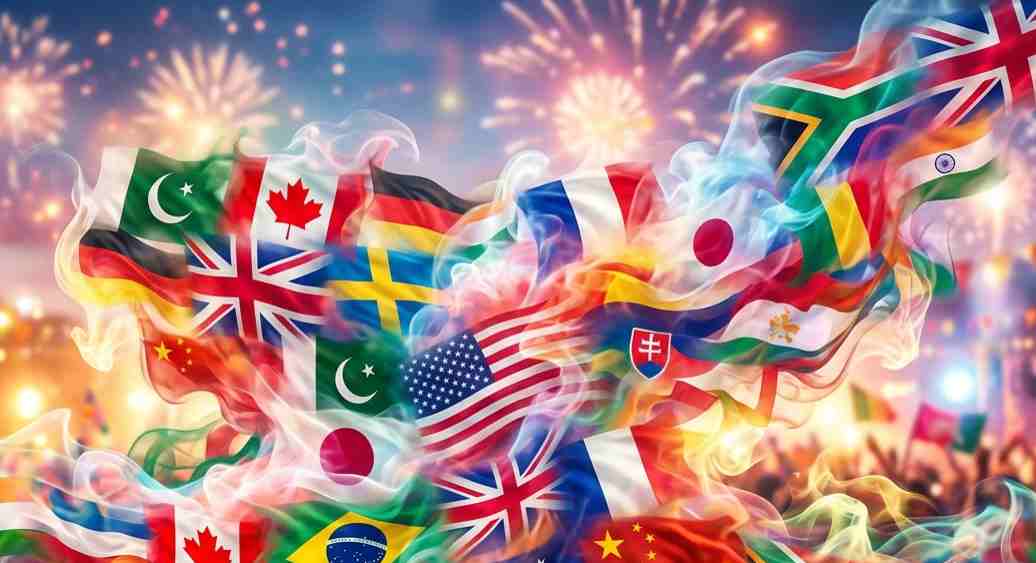
Flags are far more than decorative pieces of fabric fluttering outside government buildings or floating above stadium bleachers. They are sovereign emblems, visual shorthand for a nation’s history, and concentrated snapshots of a culture's deepest values. Every color choice, geometric ratio, and emblem carries stories of independence struggles, religious traditions, geographical landmarks, and shared sacrifices.
For travelers, learning to read flags is more than a fun trivia party trick—it is a practical skill that enhances safety, builds immediate local rapport, and unlocks a deeper understanding of the places you visit.
Why Flag Literacy Matters for Travelers
While memorizing vexillological details (vexillology being the formal study of flags) might sound like a niche hobby, recognizing global banners offers tangible benefits on the ground:
- Diplomatic Navigation & Safety: During civil unrest, natural disasters, or lost travel documentation, spotting your home country's flag flying outside a building immediately identifies safety at an embassy or consulate. Recognizing regional flags can also help you identify official government transport or border checkpoints.
- Building Instant Rapport: Recognizing local or national flags during sports events, cultural festivals, or regional celebrations shows respect and awareness. Cheering alongside locals while accurately recognizing their regional or national symbols transforms you from a passive tourist into an engaged guest.
- Avoiding Cultural Faux Pas: Flag etiquette is taken very seriously across the globe. In many countries, allowing a flag to touch the ground, displaying it upside down, or wearing it as casual clothing can cause genuine offense or violate local desecration laws. Knowing the context behind a flag prevents unintentional disrespect.
Breaking the Mold: Nepal’s Non-Quadrilateral Flag
If you ask anyone to draw a flag, almost everyone defaults to a rectangle. Even flags with unique proportions—like Qatar's unusually long layout or Switzerland's perfectly square banner—still adhere to a four-sided, quadrilateral shape.
Nepal completely shatters this convention.
Nepal is the only sovereign nation in the world with a non-quadrilateral national flag. Its distinctive design consists of two stacked triangles (known as a double pennon):
- The Geometry: The two triangles symbolize the soaring peaks of the Himalayas, which dominate the country's landscape.
- The Celestial Bodies: The upper triangle features a crescent moon, and the lower triangle features a 12-pointed sun. Historically, these represented the Shah and Rana dynasties, but today they symbolize the hope that Nepal will endure as long as the sun and moon remain in the sky.
- The Colors: Crimson red forms the base—Nepal’s national color and the color of the rhododendron flower—bordered by a deep blue edge representing peace and harmony.
The Tricky Twins: Correcting Common Flag Confusion
For travelers navigating foreign airports or international sporting events, near-identical flag designs frequently cause confusion. However, several common assumptions about these flags are factually incorrect.
Fact Check & Correction:
- Germany vs. Belgium: Germany uses a horizontal tricolor (black, red, gold), whereas Belgium uses a vertical tricolor (black, yellow, red). They are not both horizontal.
- France vs. Russia vs. Netherlands: France uses a vertical tricolor (blue, white, red). Russia and the Netherlands use horizontal tricolors—Russia ordered white-blue-red from top to bottom, and the Netherlands ordered red-white-blue.
- Count of Star Flags: Stars do not merely appear on "about 40 flags." In reality, over 60 sovereign flags feature stars as primary visual elements, ranging from single prominent stars (like Vietnam or Ghana) to constellation layouts (like Brazil or Australia).
Here is how to quickly tell apart some of the world's most famously confused flag pairs:
| Flag Pair | Primary Difference | How to Remember |
| Ireland vs. Côte d’Ivoire | Striping orientation and order. Ireland is green-white-orange from left to right. Côte d’Ivoire is orange-white-green. | Ireland starts with Green for the Emerald Isle on the flagpole hoist side. |
| Australia vs. New Zealand | Star count and color. Australia features six white stars (including a large 7-pointed Commonwealth Star). New Zealand features four red stars with white outlines. | Australia has more stars and they are pure white; New Zealand’s stars represent the Southern Cross in red. |
| Chad vs. Romania | Shade of blue. Both feature vertical blue-yellow-red stripes, but Chad uses a darker indigo blue, while Romania uses cobalt blue. | Virtually indistinguishable to the naked eye without side-by-side color matching! |
| Indonesia vs. Monaco | Proportions and color shade. Both are horizontal red-over-white bands, but Monaco’s flag is narrower (4:5 ratio) compared to Indonesia’s standard layout (2:3 ratio). | Poland uses the exact opposite layout: white over red. |
Sacred Emblems: Celestial Stars, Crescents, and Unyielding Flags
Stars and crescents are among the most recognizable symbols in vexillology. While often associated with the Islamic world today due to their presence on flags like Turkey, Pakistan, Algeria, and Malaysia, the crescent and star motif originally pre-dates Islam, originating in ancient Mediterranean and Central Asian iconography before being popularized globally by the Ottoman Empire.
In American vexillology, the 50 stars on the U.S. flag represent the current 50 states, while the 13 stripes represent the original colonies—a design that has evolved 26 times as new states joined the union.
Flags That Never Bow: The Half-Mast Exception
Flying a flag at half-mast is a near-universal international sign of mourning following a major tragedy or the death of a head of state. However, a small group of national flags are legally and religiously forbidden from ever being lowered to half-mast:
- Saudi Arabia: Features the Shahada (the Islamic declaration of faith) written in Arabic calligraphy above a sword. Lowering the sacred text is considered blasphemous.
- Iraq: Features the Takbir ("Allah is the Greatest") in green Kufic script between three stars.
- Somaliland: Displays the Shahada across its top green stripe.
If these nations need to express national mourning, they hoist ordinary solid banners or modify protocol without lowering their sacred flags.
Circles, Wheels, and Central Focus
Circular motifs are frequently used in flag design to represent unity, eternity, or the sun. However, the meaning behind these central shapes varies dramatically:
- Japan (Hinomaru): Features a simple red disc centered on a plain white field. It represents the sun (Nippon translates to "origin of the sun"), drawing from Japan's Shinto heritage and connection to the sun goddess Amaterasu.
- Bangladesh: Features a red circle set on a dark green field. The red disc represents the sun rising over Bengal and the blood spilled during the 1971 Liberation War. Notably, the red disc is intentionally offset slightly toward the hoist side so that it appears centered when the flag is flying in the wind.
- India (Tiranga): Features the Ashoka Chakra at its center—a 24-spoke navy blue wheel representing the eternal wheel of law (Dharma) and constant progression.
- Brazil: Features a blue celestial sphere depicting the night sky over Rio de Janeiro on November 15, 1889 (the day the republic was proclaimed), complete with 27 stars representing the states and federal district, overlaid with the national motto "Ordem e Progresso" (Order and Progress).
The World's Oldest Flags and the Nordic Cross
When discussing flag longevity, historical precision matters.
Fact Check & Correction:
The Danish flag (the Dannebrog) is not merely "over 350 years old." Documented historical records date the Dannebrog back to at least the 14th century, with legendary origins tracing to the Battle of Lyndanisse in 1219. It was officially recognized for merchant use in 1625, giving it an unbroken continuous history of over 600 to 800 years—making it the Guinness World Record holder for the oldest continuously used national flag.
The Nordic Cross Family
The design of the Dannebrog—a off-center Christian cross on a solid background—became the structural foundation for the entire Nordic region.
Every main Scandinavian and Nordic nation incorporates this distinctive layout, shifting colors to reflect their unique history:
- Sweden: Yellow cross on a sky-blue field (inspired by the Swedish coat of arms).
- Norway: Indigo blue cross outlined in white on a red field (incorporating colors of liberty shared with France, the UK, and the USA).
- Finland: Blue cross on a white field (representing the country's thousands of lakes and winter snows).
- Iceland: Red cross outlined in white on a deep blue field (symbolizing volcanic fire, ice, and the surrounding ocean).
Color Families: What Flag Colors Really Mean
No nation today uses a single solid-colored flag. While historical examples exist—such as the plain white flag used by the Kingdom of France during the Bourbon Restoration or the solid green flag of Libya under Muammar Gaddafi (1977–2011)—modern international recognition standards demand distinct, multi-colored designs.
When you look across regional maps, you quickly notice that neighboring flags often share identical color palettes. These are known as color families, and they signal shared historical, political, or cultural heritage:
1. Pan-African Colors (Green, Yellow, Red)
Inspired by the flag of Ethiopia, the only native African nation to successfully resist 19th-century European colonization. As other African nations gained independence in the mid-20th century, many adopted Ethiopia's red, yellow, and green palette (often adding black) to symbolize sovereignty and solidarity (e.g., Ghana, Senegal, Mali, Cameroon).
2. Pan-Arab Colors (Black, White, Green, Red)
Based on the banner flown during the 1916 Arab Revolt against Ottoman rule. Each color represents a historical Islamic dynasty:
- Black: The Rashidun and Abbasid Caliphates.
- White: The Umayyad Caliphate.
- Green: The Fatimid Caliphate and traditional color of Islam.
- Red: The Hashemite dynasty and courage.
- Nations utilizing this palette include Jordan, Palestine, the United Arab Emirates, Kuwait, and Egypt.
3. Pan-Slavic Colors (Red, Blue, White)
Derived from the 1848 Prague Slavic Congress and modeled after the Russian flag. These colors were adopted by many Slavic nations across Eastern Europe to symbolize shared cultural roots (e.g., Slovakia, Slovenia, Serbia, the Czech Republic, and Croatia).
Becoming an Observant Traveler
The next time you land in a new country, take a moment to look up at the banner flying over the terminal or government buildings. Pay attention to the proportions, the choice of colors, and the central emblems.
When you understand the grammar of vexillology, a flag ceases to be just a piece of screen-printed fabric. It becomes an open history book—offering immediate insight into the geography, religious heritage, alliances, and defining moments of the people whose land you are visiting.