Mont Saint-Michel: The Citadel of the Tides
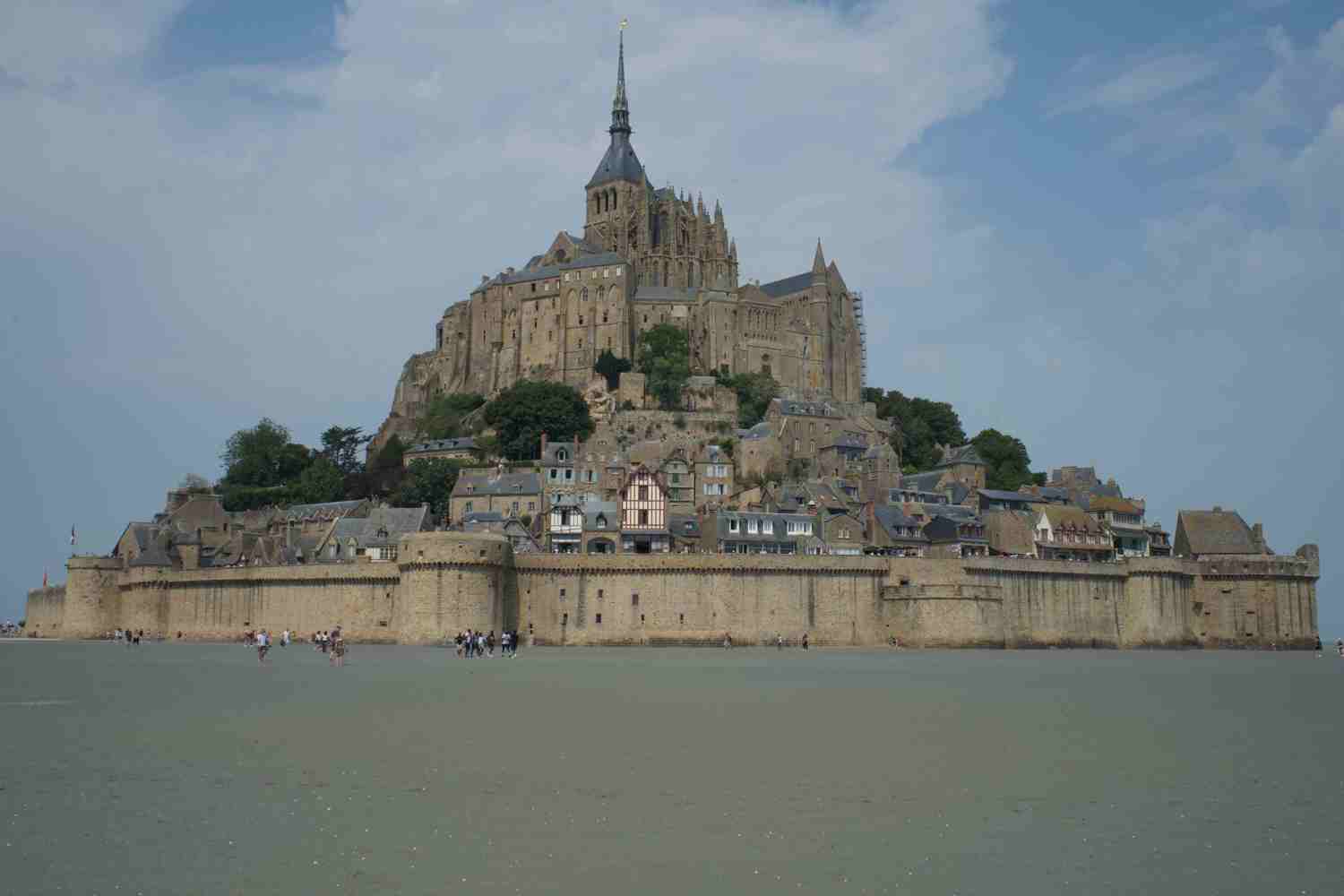
At first glance, rising dramatically from the vast salt marshes and shimmering mudflats of the Normandy coast, Mont Saint-Michel looks like something pulled straight out of a fairy tale. Its soaring Gothic spires, fortified granite walls, and cascading medieval village create a silhouette so fantastical that pop culture frequently borrows its likeness—most famously inspiring the Kingdom of Corona in Disney’s Tangled and the majestic city of Minas Tirith in The Lord of the Rings.
Yet, despite its imposing battlements and defensive turrets, Mont Saint-Michel is not a castle built for royalty. It is, instead, one of humanity’s most astonishing architectural achievements: a sacred tidal island and Benedictine abbey where human devotion has intertwined with the untamed rhythms of the Atlantic Ocean for over twelve centuries. Drawing nearly three million visitors each year, it stands as France’s second most visited monument outside of Paris and a UNESCO World Heritage site of unparalleled historic weight.
To truly understand Mont Saint-Michel, however, one must look beyond the postcard views. Behind its iconic stone facade lies a complex history of visions, military sieges, prison cells, and environmental restoration—alongside a fair share of modern travel myths that deserve setting straight.
Deconstructing the Misconceptions: Castle, Fortress, or Abbey?
One of the most persistent misunderstandings surrounding Mont Saint-Michel is its fundamental purpose. Visitors arriving at the base of the island are greeted by thick ramparts, arrow slits, and heavy wooden gates—hallmarks of a medieval castle or military fortress. While the island certainly served a defensive role during times of war, its true heart has always been spiritual.
The unique structure of Mont Saint-Michel is actually a physical representation of feudal society and divine order. At the absolute base of the granite rock lies the village, historically housing merchants, fishermen, and laborers. Above them sit the fortified walls and garrison quarters built to protect the sanctuary. At the highest point, soaring over 300 feet (92 meters) above sea level, stands the Abbey church, capped by a gold-gilded statue of Archangel Michael slaying a dragon.
The architectural layout dictates a clear message: God sits above all, supported by the church, defended by soldiers, and sustained by the working community below. It is a self-contained medieval ecosystem designed not for a king or noble lord, but for a community of monks seeking solitude and spiritual contemplation amidst the tides.
A Millennium of History: Visions, Warfare, and Revolution
The story of Mont Saint-Michel begins in the year 708 AD with a dramatic legend. According to medieval texts, Saint Aubert, the Bishop of the nearby hilltop town of Avranches, was visited in a dream by Archangel Michael. The archangel instructed Aubert to build a sanctuary on the isolated granite outcrop then known as Mont Tombe. Legend has it that Aubert initially ignored the vision, prompting the archangel to return and press his finger into the bishop's skull to command obedience—a skull displaying a mysterious circular hole is still preserved today in the Church of Saint-Gervais in Avranches!
Whether spurred by divine intervention or strategic foresight, Aubert built a small sanctuary dedicated to the archangel, consecrating it on October 16, 708. By 966 AD, Duke Richard I of Normandy invited Benedictine monks to establish a permanent monastery on the rock, transforming the humble sanctuary into a bustling intellectual and religious hub.
The Unconquered Fortress of the Hundred Years' War
As conflict between England and France escalated during the Hundred Years’ War (1337–1453), Mont Saint-Michel was fortified with massive stone walls, towers, and ramparts. The English military launched repeated sieges against the island, including a brutal 30-year blockade in the 15th century. Yet, despite being surrounded by hostile forces, Mont Saint-Michel never fell to the English. Its natural defenses—treacherous quicksand, raging tides, and steep stone walls—proved completely impenetrable.
The "Bastille of the Sea"
The French Revolution of 1789 brought a radical shift to the island’s history. The Benedictine monks were driven out, religious property was confiscated by the state, and the glorious Abbey was repurposed into a high-security state prison. Known colloquially as the Bastille de la Mer ("Bastille of the Sea"), the complex held political dissidents, anti-clerical priests, and dangerous criminals in cramped, cold conditions.
The prison operated for over 70 years until public outcry—led by prominent cultural figures like writer Victor Hugo—forced Emperor Napoleon III to close the facility in 1863. Hugo famously wrote that Mont Saint-Michel was to France what the Great Pyramid was to Egypt, urging the nation to preserve its architectural soul. In 1874, the site was declared a historic monument, initiating a massive restoration effort led by visionary architects such as Édouard Corroyer. In 1979, UNESCO inscribed Mont Saint-Michel and its bay on the World Heritage list.
Inside La Merveille: The Architectural Miracle
Climbing the steep cobblestone path known as the Grand Rue leads visitors to the summit and into the Abbey complex itself. The crowning jewel of this architectural ensemble is known as La Merveille ("The Marvel"), a masterpiece of Northern French Gothic architecture built on the northern side of the rock during the early 13th century.
Because the granite summit offered very little flat ground, master builders had to stack the monastery rooms across three soaring vertical levels, resting massive stone vaults directly against the natural rock slopes.
The interior spaces reflect the daily routines of monastic life:
- The Cloister: Suspended on the top floor between sky and sea, this serene courtyard features double rows of delicate granite columns offset in a zigzag pattern. It offered monks a peaceful space for prayer and meditation with panoramic views of the bay.
- The Refectory: A light-filled dining hall featuring high vaults and narrow windows set into deep recesses, creating a soft, ethereal illumination without weakening the structural walls.
- The Knights' Hall (Salle des Chevaliers): Located directly beneath the Cloister, this massive columned room served as the primary workroom and study space for monks copying illuminated manuscripts.
- The Guest Hall (Salle des Hôtes): Designed to receive high-ranking pilgrims, kings, and nobility with grand fireplaces and soaring ceilings.
Navigating through these cavernous stone halls offers a profound appreciation for medieval engineering—every stone block had to be transported across the shifting sands by boat at high tide or hauled up the cliffside using horse-drawn carts and giant treadwheels.
Life on the Rock: Who Actually Lives Here Today?
During peak summer hours, the narrow streets of Mont Saint-Michel hum with thousands of tourists, gift shops, and bustling restaurants. It is easy to assume the island is merely an open-air museum or a commercial tourist set. However, Mont Saint-Michel remains a living, breathing village with an active spiritual core.
The Real Permanent Population
Contrary to common claims that 30 to 50 people live on the rock, the true permanent resident population is significantly smaller. Today, only about 15 to 25 people call the island their full-time home. This tiny resident group consists primarily of:
- Monks and Nuns: Members of the Monastic Communities of Jerusalem, who reside in the Abbey, maintaining daily cycles of prayer, mass, and spiritual service.
- A Few Local Villagers: Shopkeepers, hoteliers, and long-time residents whose families have maintained property on the island for generations.
The Nighttime Transformation
During the daytime, hundreds of workers—including French gendarmes, administrators, curators, sanitation teams, and restaurant staff—commute across the causeway from the mainland. But when the last shuttle bus departs in the evening, the island undergoes a breathtaking shift. The crowds vanish, the shops lower their shutters, and an ancient, profound silence settles over the cobblestones. Walking through the dimly lit stone alleys at night offers a rare glimpse into the medieval atmosphere that has endured here for over a thousand years.
The Untamed Rhythm of the Tides
The Bay of Mont Saint-Michel is home to some of the highest and most extreme tides in Continental Europe, with water levels fluctuating up to 14 meters (46 feet) between high and low tide. Driven by the gravitational pull of the moon and the shallow, funnel-shaped geography of the English Channel, the sea recedes over 15 kilometers (9 miles) at low tide, exposing vast mudflats, before sweeping back in to engulf the bay.
Busting the "Galloping Horse" Myth
A famous quote attributed to French writer Victor Hugo claims that the tide returns "à la vitesse d'un cheval au galop" (at the speed of a galloping horse). While poetic, this is factually inaccurate.
In reality, the incoming tide moves at roughly 4 to 6 kilometers per hour (2.5 to 3.7 mph)—about the speed of a brisk human walk. However, because the tidal flats are almost completely flat, the rising water fills hidden channels and estuaries with alarming speed, easily trapping unsuspecting walkers who wander into the bay without a guide.
The Saving of the Island: The 2014 Engineering Feat
For decades, human intervention threatened to ruin Mont Saint-Michel's island status. In 1879, a permanent raised road causeway was constructed to connect the rock to the mainland. Unfortunately, the causeway trapped sediment and silt carried by the tides, causing the surrounding bay to gradually turn into dry salt marsh land (prés salés).
To prevent Mont Saint-Michel from becoming permanently landlocked, the French government launched a massive 10-year hydraulic engineering project completed in 2014:
- Removal of the Old Causeway: The solid dirt road was demolished and replaced with a sleek, elevated pedestrian bridge built on slender stilts.
- Hydraulic Dam Construction: A new dam was built on the Couesnon River to flush accumulated silt out into the ocean during low tide.
- Restoration of Tidal Flow: Water can now flow freely beneath the pedestrian bridge, allowing high tides (when the tidal coefficient exceeds 110) to completely encircle Mont Saint-Michel once again, turning it into a true island for roughly 20 days each year.
Safety Warning: The mudflats around Mont Saint-Michel contain patches of dangerous quicksand (sables mouvants). Never attempt to walk across the bay surrounding the island without a licensed professional bay guide (guide de baie).
Practical Travel Guide: Logistics, Costs, and Rules
Planning a visit to Mont Saint-Michel requires balancing travel time, tidal schedules, and seasonal crowds. Here is what you need to know to make the most of your journey:
How to Get There from Paris
Mont Saint-Michel is located in southwestern Normandy, near the border with Brittany, approximately 300 to 360 kilometers (185 to 220 miles) west-southwest of Paris. While it can be visited as a long day trip, an overnight stay yields a much richer experience.
- By Train & Shuttle: Take the high-speed TGV train from Paris Montparnasse station to Rennes or Dol-de-Bretagne (approx. 1.5 to 2 hours), followed by a direct regional Keolis bus to the Mont Saint-Michel visitor center (approx. 50 minutes).
- By Car: Driving from Paris via the A13 and A84 motorways takes roughly 3.5 to 4 hours. Visitors must park in designated mainland parking lots (Parking du Mont Saint-Michel) and take a free electric shuttle bus (Passeur) or walk 30 minutes across the bridge.
Entry Fees and Abbey Tickets
Access to the village streets, ramparts, and causeway bridge is 100% free 24 hours a day. However, entering the Abbey at the summit requires an admission ticket:
- Standard Adult Ticket: Approximately €13 to €15 (prices vary slightly during peak season).
- Free Admission: Available for visitors under 18 years old, EU citizens/residents aged 18 to 25, individuals with disabilities and their accompanying companion, and job seekers (proof of eligibility/ID required).
- Advance Booking: Booking timed-entry tickets online in advance via the official Centre des Monuments Nationaux website is strongly recommended, especially between May and September, to skip long queues.
Fact Check: Is There a Strict Dress Code?
A common misconception among travelers is that Mont Saint-Michel enforces a strict religious dress code (such as requiring covered knees or shoulders like St. Peter's Basilica in Rome). This is incorrect.
There are no mandatory clothing restrictions or dress code inspections at the entrance. However, because the Abbey remains an active sanctuary and coastal weather can be harsh, thoughtful dressing is recommended:
- Layering for Coastal Winds: Atlantic winds whipping across the bay can be cold and intense; bring a windproof jacket.
- Sturdy Walking Shoes: The village paths feature steep incline cobblestones, stone stairs, and uneven surfaces—leave high heels and smooth-soled sandals behind.
- Respectful Attire: Out of courtesy for the religious community inside the Abbey sanctuary, modest, comfortable attire is appreciated.
Culinary Highlights: What to Eat
No trip to the island is complete without tasting local culinary specialties:
- La Mère Poulard Omelet: Famous since 1888, these ultra-fluffy, soufflé-like omelets are cooked in copper pans over an open wood fire. While expensive, watching them be prepared is a local tradition.
- Pre-Salted Lamb (Agneau de Pré-Salé): Sheep that graze on the salty coastal marshes around the bay produce meat with a distinct, tender flavor prized across France.
- Normandy Cider & Biscuits: Enjoy local dry apple cider paired with traditional butter galettes.
Essential Visitor Summary
To quickly reference key facts before planning your trip, keep these details in mind:
| Key Aspect | Details & Recommendation |
| Location | Normandy, France (~300–360 km from Paris) |
| Annual Visitors | ~3 Million (2nd most visited site in France outside Paris) |
| Permanent Inhabitants | ~15–25 people (Monks, nuns, local families) |
| Abbey Ticket Price | ~€13–€15 (Free for under 18s & EU under 26) |
| Island Access Fee | Free (Village, ramparts, and bridge are open 24/7) |
| Tidal Variation | Up to 14 meters (46 feet) — Europe's highest tides |
| Best Time to Visit | Early morning or late evening (overnight stay recommended) |
Whether you come to marvel at its centuries of Gothic engineering, witness the dramatic surge of the Atlantic tides, or simply wander its ancient cobblestone alleyways in the quiet evening air, Mont Saint-Michel offers an experience unlike anywhere else on Earth. It stands not as a monument frozen in time, but as a living bridge between human ambition, spiritual faith, and the natural world.